
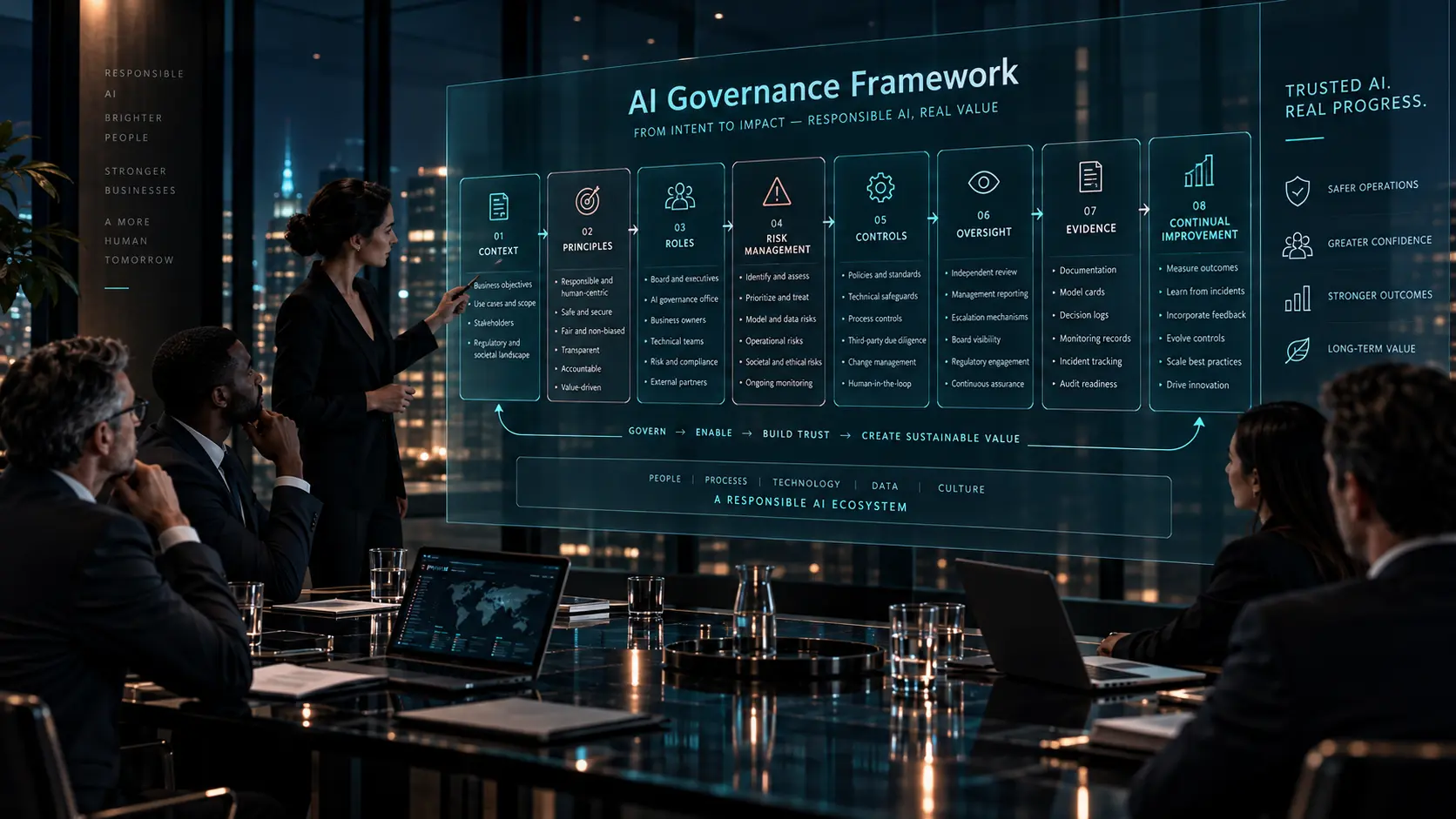
What is an AI governance framework?
An AI governance framework is an organised structure for directing, controlling and overseeing how an organisation develops, acquires or uses AI systems.
It connects decisions that would otherwise remain scattered across different functions. Our guide to AI governance explains the broader foundation.
It should help answer what AI systems exist, why they are used, who is accountable, what risks and controls apply, who can approve new uses, what evidence must be kept, how changes are detected and when systems must be reviewed.
The framework is the governance architecture. It does not replace operational procedures; it organises them.
What an AI governance framework is not
A framework is not a single policy, ethical code, risk matrix, inventory, approved-tools list, committee, certification or standard. Each may form part of the model, but none constitutes the entire framework. An AI use policy is one operational component.
Nor should an organisation simply copy a generic model. A business using two generative assistants does not necessarily need the same arrangements as one building its own systems and making decisions about people.
The framework should be proportionate to the organisation’s AI exposure and complexity; there is no single universal structure.
Start with context and objectives
Before designing processes and controls, understand what the organisation wants to achieve: why it uses AI, which benefits it expects, which risks it wants to avoid, which decisions require control, which obligations matter and what degree of autonomy it accepts.
The framework should support strategy. It should neither create unnecessary barriers to adoption nor allow every department to adopt systems without shared criteria.
The aim is a sensible balance between innovation, control and accountability.
Define the scope
A framework needs clear boundaries. It may cover the whole organisation or selected units, processes, systems or use cases.
An initial scope may prioritise decisions about people, critical processes, sensitive information, large-scale tools, third-party solutions and internal developments.
Scope can expand as maturity grows. Avoid making it so wide that it cannot be managed or so narrow that major risks remain outside it.
Establish governance principles
Principles may cover responsible use, human oversight, proportionality, transparency, security, privacy, traceability, fairness, accountability and continual improvement.
They must lead to decisions and controls. “Human oversight”, for example, should clarify where it is needed, who performs it, what authority that person holds, which evidence it creates and when a process may be stopped.
That is where a principle becomes governance.
Build the AI system inventory
An organisation cannot govern what it does not know. The AI inventory is therefore one of the framework’s first operational components.
It may record the system, purpose, owner, supplier, users, process, data, affected population, level of autonomy, classification, risks, controls and review date.
It must not become a static repository. New systems and significant changes should trigger the appropriate updates, making the inventory an entry point into governance.
Define roles and responsibilities
The framework should remove unclear accountability. An organisation may not need new job titles, but it should know who proposes, assesses, approves, implements, monitors, maintains, audits, escalates and reports incidents.
Leadership, business, technology, data, security, risk, compliance, legal, privacy, procurement and audit may all contribute. A clear model of roles and responsibilities helps.
The objective is not a complicated matrix, but a clear answer to: who has authority to decide?
Integrate risk and impact
The framework should include a common AI risk management process covering identification, assessment, treatment, controls, residual risk, acceptance and monitoring.
Some systems also require a deeper impact assessment, considering affected people, rights, consequences, reversibility, vulnerability and oversight.
Assessment should be proportionate. An internal drafting tool does not necessarily require the same analysis as a system influencing recruitment. AI Act classification can provide regulatory context where relevant.
Define controls and acceptable-use criteria
The framework translates risk and principles into organisational, technical, procedural and contractual controls.
These may cover approvals and segregation of duties; access, logging, validation and monitoring; assessments, testing, reviews and escalation; and supplier requirements, information, incidents and changes.
It should also define approved tools, restricted uses, uses requiring authorisation, information that may be entered and decisions requiring human review. The purpose is consistent decision-making.
Integrate suppliers and third parties
Much organisational AI arrives through enterprise software, cloud platforms, APIs, assistants, embedded features and specialist suppliers.
Third-party management should consider purpose, data, security, documentation, changes, sub-suppliers, contractual terms, incidents, continuity and exit arrangements.
Supplier governance must begin before a contract is signed, as part of the decision process.
Organise evidence and traceability
A framework must be demonstrable. Relevant evidence may include inventories, assessments, approvals, decisions, controls, testing, training, reviews, incidents, audits and corrective actions.
Traceability should allow the organisation to reconstruct: system → decision → risk → control → accountable person → evidence → review.
The goal is not to keep everything, but to retain what shows how AI is governed.
Define metrics, monitoring and incident management
Governance does not end with approval. Metrics may cover inventoried systems, completed assessments, open risks, pending controls, reviewed suppliers, training, incidents, reviews and corrective actions.
People should also know what to report, to whom, when to escalate and who may suspend a use. Monitoring keeps the framework alive.
How to build an AI governance framework step by step
Step 1. Understand the context
Identify strategy, current uses, risks and needs.
Step 2. Define objectives
Set out what the governance model must achieve.
Step 3. Define the scope
Choose the initial units, processes and systems.
Step 4. Establish principles
Set the organisation’s broad decision criteria.
Step 5. Build the inventory
Identify existing systems.
Step 6. Define roles
Assign accountability and authority.
Step 7. Create assessment processes
Define how new systems and changes are reviewed.
Step 8. Integrate risk and impact
Use consistent assessment criteria.
Step 9. Design controls
Translate risk and principles into practical safeguards.
Step 10. Integrate suppliers
Include AI in procurement and third-party management.
Step 11. Define evidence
Specify which records each process should create.
Step 12. Create metrics
Measure operation and outcomes.
Step 13. Manage incidents
Define escalation, responsibilities and decisions.
Step 14. Audit and review
Check whether the model works.
Step 15. Improve
Update the framework using experience, change and results.
The organisation does not need to design everything at once. The framework can be built progressively.
How to know whether the framework is working
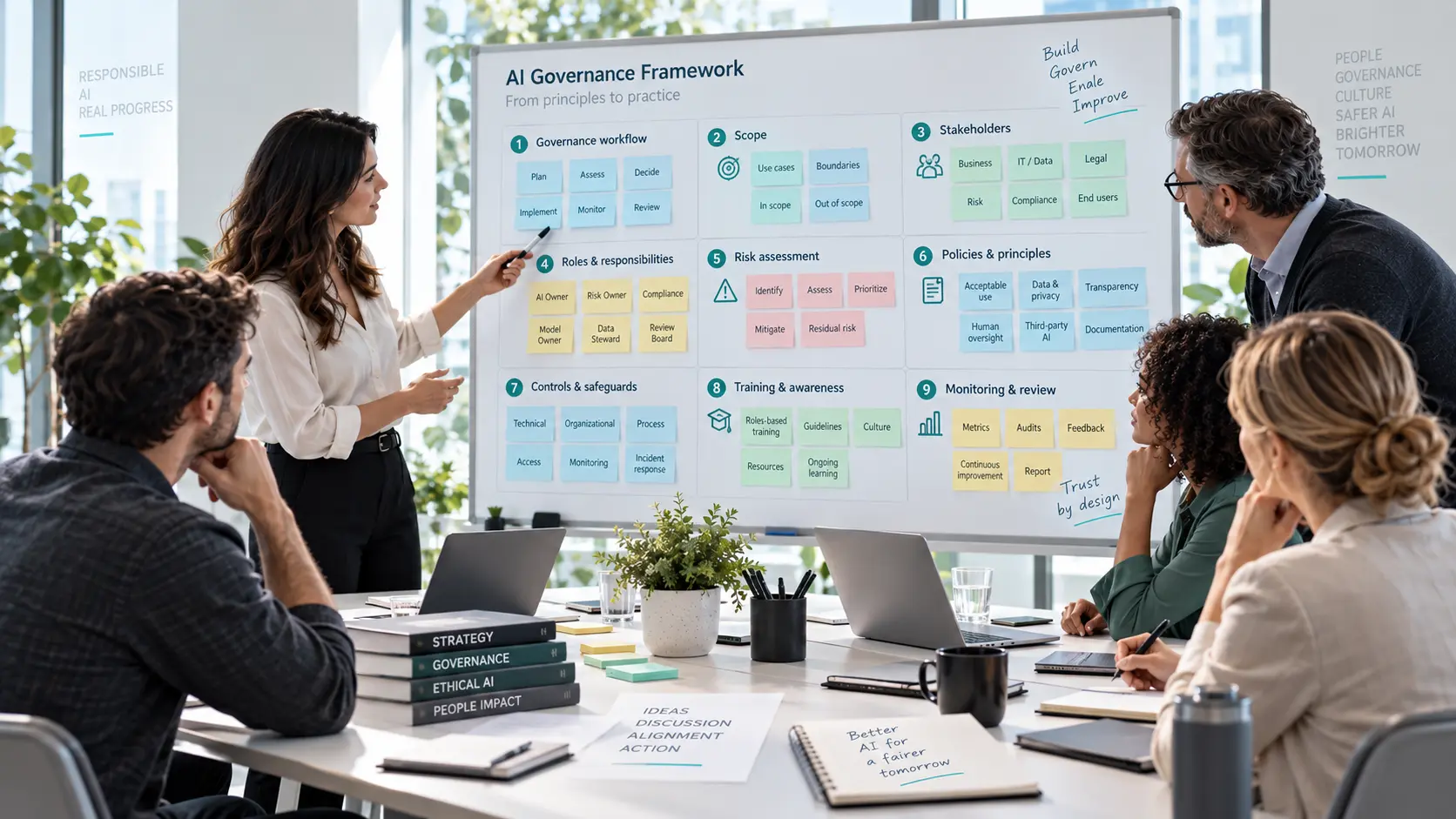
A framework does not work because it has many pages. It works when it supports decisions.
Positive signs include known systems and owners, assessments before deployment, treated risks, reviewed suppliers, evidenced decisions, understood rules, escalated incidents, change-triggered reviews and useful information reaching leadership.
Take one system from the inventory and ask who approved it, why, what risk it presents, which controls exist, who operates them, what evidence they generate and when the system is reviewed.
If those questions receive coherent answers, the framework is working.
Common mistakes
Starting with a committee
A committee may help, but first define which decisions it must make.
Copying a generic model
The framework must fit the organisation’s real context.
Creating too many processes
Unnecessary complexity reduces adoption.
Separating business and governance
AI must be governed within real business processes.
Ignoring suppliers
An external system still requires governance of how the organisation uses it.
Confusing governance with compliance
Compliance matters, but governance also covers strategy, risk, operations and monitoring. ISO/IEC 42001 can support the management system, while ISO 42001 and the AI Act serve different purposes.
Failing to measure
What is not monitored tends to become a static policy.
Failing to update
The framework must evolve as the organisation’s use of AI changes.
A useful framework turns principles into decisions
Governing AI does not mean adding another layer of bureaucracy. It means ensuring that AI decisions follow common criteria, that someone knows what to review and has authority to decide, that risks lead to controls, controls leave evidence and results support improvement.
A strong AI governance framework connects strategy, people, processes, technology, risk and trust.
When these elements work together, governance stops being theoretical and becomes part of the business.
References
- ISO/IEC 42001:2023 — Artificial intelligence management system.
- ISO/IEC 23894:2023 — Guidance on AI-related risk management.
- ISO/IEC 42005:2025 — AI system impact assessment.
- NIST AI Risk Management Framework — AI RMF.
Does your organisation already have an AI governance model?
Before designing a complete framework, it is useful to understand which AI systems already exist, what risks they present and which governance elements are already working.
Start the diagnostic →
Céntrika’s diagnostic can help identify that starting point.